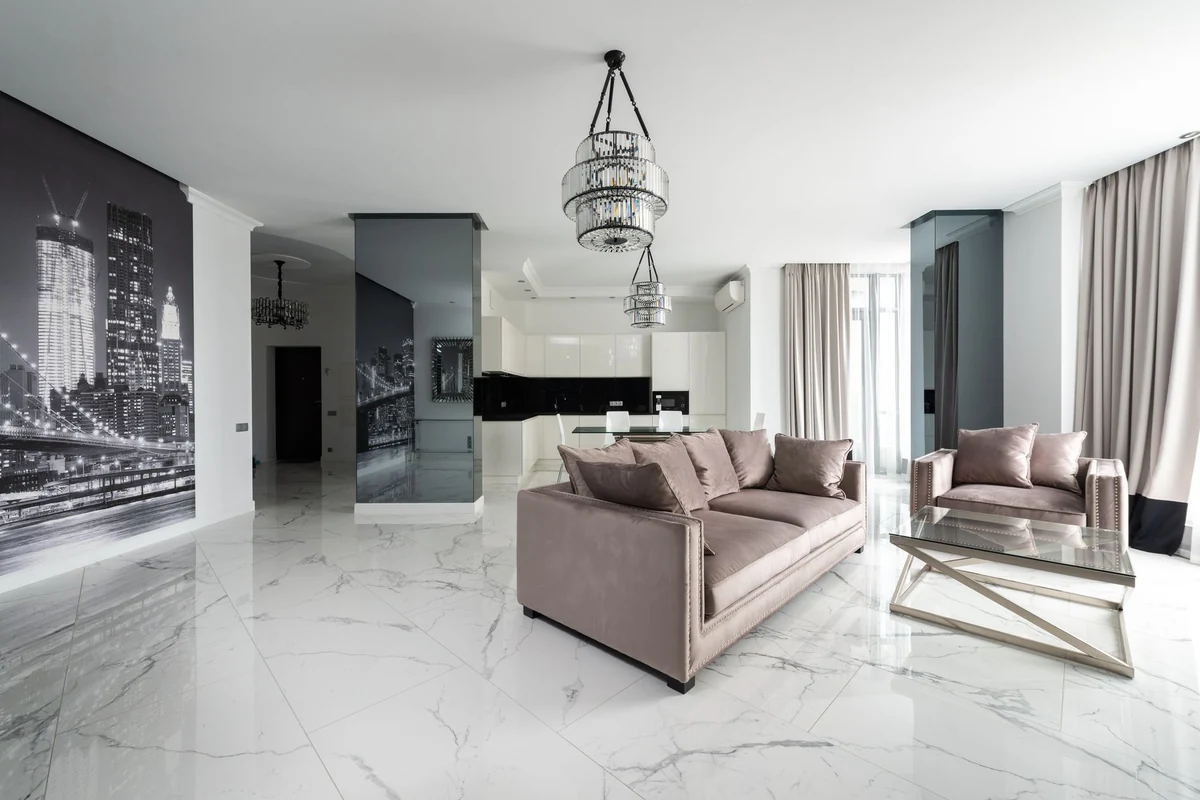
The coast gets the postcards, but a large share of Los Angeles lives in the valleys: the San Fernando Valley, the Santa Clarita Valley and the San Gabriel Valley. Summers there run much hotter than at the beach. Heat waves push well past 100°F, and on September 6, 2020, Woodland Hills reached 121°F, the highest temperature ever recorded in Los Angeles County. Add dry Santa Ana winds, strong sun, hard water and some of the most active faults in the region, and tile in the valleys needs a little more care than tile in Santa Monica.
This guide focuses on what that means inside the house and on the job site: choosing floor tile for hot, sunny rooms, planning movement joints, installing in the heat, dealing with hard water, and building for earthquakes. For patio, pool deck and driveway specifics, see our separate guide to outdoor tile for LA patios, pool decks and driveways.
What Makes the Valleys Hard on Tile
Heat and sun
Inland valleys lose the marine layer that keeps coastal neighborhoods mild, so long stretches of 95 to 105°F days are normal in summer. Sunlight through west- and south-facing glass heats floors directly, and slabs and framing expand and contract with those daily swings. Tile itself handles heat well. What fails is usually the system around it: missing movement joints, poor bonding, or installation shortcuts taken on a hot day.
Dry air and Santa Ana winds
Low humidity and hot, dry winds pull water out of fresh mortar and grout faster than normal. That shortens working time and can weaken the bond if the installer does not adjust.
Earthquakes
The valleys have firsthand experience. The 1971 San Fernando earthquake and the 1994 Northridge earthquake were both centered in the San Fernando Valley, and both cracked a lot of tile. A tile assembly with proper movement joints and a crack-isolation or uncoupling layer rides out small movements far better than tile bonded straight to a slab.
Interior Floor Tile for Hot Valley Homes
Tile is one of the best floors for a hot climate. It stays cool underfoot in an air-conditioned house and it does not warp or gap from heat. The best performers in valley homes:
- Large-format porcelain: 24x24 and 24x48 porcelain is dense, stable and low maintenance. Light and mid-tone neutrals help rooms feel brighter and cooler.
- Wood-look porcelain planks: The look of wood without wood's movement or moisture concerns. If you are comparing it with vinyl plank for a sun-drenched room, check the vinyl maker's limits on temperature and direct sun; porcelain has no such limits.
- Stone-look and concrete-look porcelain: Fits the ranch, mid-century and newer contemporary homes common across the valleys.
Color matters more than people expect in rooms with big west-facing windows. Dark tile in direct afternoon sun gets noticeably warm to the touch; lighter tile reflects more of that energy and stays more comfortable.
Movement Joints: The Detail That Prevents Cracks
The Tile Council of North America's movement joint guideline (EJ171) is the industry reference here, and it treats sun-exposed interiors differently from ordinary rooms:
- Interior areas: movement joints roughly every 20 to 25 feet in each direction.
- Interior areas exposed to direct sunlight or moisture: roughly every 8 to 12 feet in each direction.
- Exterior areas: roughly every 8 to 12 feet in each direction.
- Everywhere: joints at the perimeter, where tile meets walls, columns and changes of plane, and over structural joints in the slab.
Movement joints are filled with a flexible sealant, not grout. In a valley family room with a wall of west-facing glass, that means planning for more joints than the same room would need on the coast. It is also a good reason to use an uncoupling or crack-isolation membrane over concrete, which our guide to installing tile on a concrete subfloor covers in more detail.
Installing Tile in the Heat
Most valley tile work happens in warm weather, so the crew's hot-weather habits matter as much as the materials:
- Follow the mortar maker's temperature limits. Thin-set and grout bags list an acceptable installation range. On days above that range, work early, shade the area, or reschedule outdoor work.
- Mix smaller batches. Hot, dry air shortens pot life and open time. Mortar that has skinned over will not bond.
- Keep the substrate cool. A sun-baked slab pulls water out of mortar immediately. Shade it and, where the manufacturer allows, dampen it before setting tile.
- Check coverage. Large-format tile needs full mortar contact. Pulling a tile now and then to check coverage is standard practice, and more important when mortar is setting fast.
- Protect fresh work. Keep new outdoor tile out of direct sun and wind while it cures.
Pro tip: If you can choose, schedule outdoor tile projects in the valleys between October and April. Cooler days give mortar and grout time to cure properly, and crews are not racing the heat.
Hard Water in Valley Bathrooms
Much of the valley area gets hard water, and the mineral film it leaves shows up fastest on shower glass, grout lines and textured tile. A few choices make cleaning easier:
- Smooth, dense wall tile: Glazed porcelain and ceramic wipe clean more easily than heavily textured or handmade surfaces.
- Stain-resistant grout: Epoxy or high-performance grout resists mineral buildup and staining better than standard cement grout. See our grout guide for the basics.
- Daily squeegee: Thirty seconds after each shower prevents most buildup.
- Natural stone: Marble and limestone react to acidic cleaners, so use stone-safe products. Our stone restoration guide explains what to do when etching happens.
Budgeting
Valley projects follow the same pricing as the rest of Los Angeles. For current ranges by material and project type, see our tile flooring cost guide and the broader Los Angeles tile installation cost guide.
Summary
Tile is an excellent choice for homes in the San Fernando, Santa Clarita and San Gabriel valleys, as long as the installation respects the climate: dense porcelain in lighter tones for sunny rooms, movement joints spaced for sun exposure, a crack-isolation or uncoupling layer over concrete, hot-weather installation habits, and grout and cleaning choices that stand up to hard water. Done that way, a tile floor stays flat, cool and crack-free through many valley summers. When you are ready to plan a project, contact Tile Los Angeles.